We make rapid maxillary expanders both ways at Thermadent: conventionally, with bands and soldered wire, and digitally, laser-sintered in cobalt chrome. Here’s how they compare.
The conventional soldered RME
A conventional Hyrax-type RME is built on molar (and sometimes premolar) bands. The bands are fitted, the wire arms are bent to the palate by hand and everything is soldered to the expansion screw. It’s a proven design that clinicians know well, and it can be made from impressions.
The sintered RME
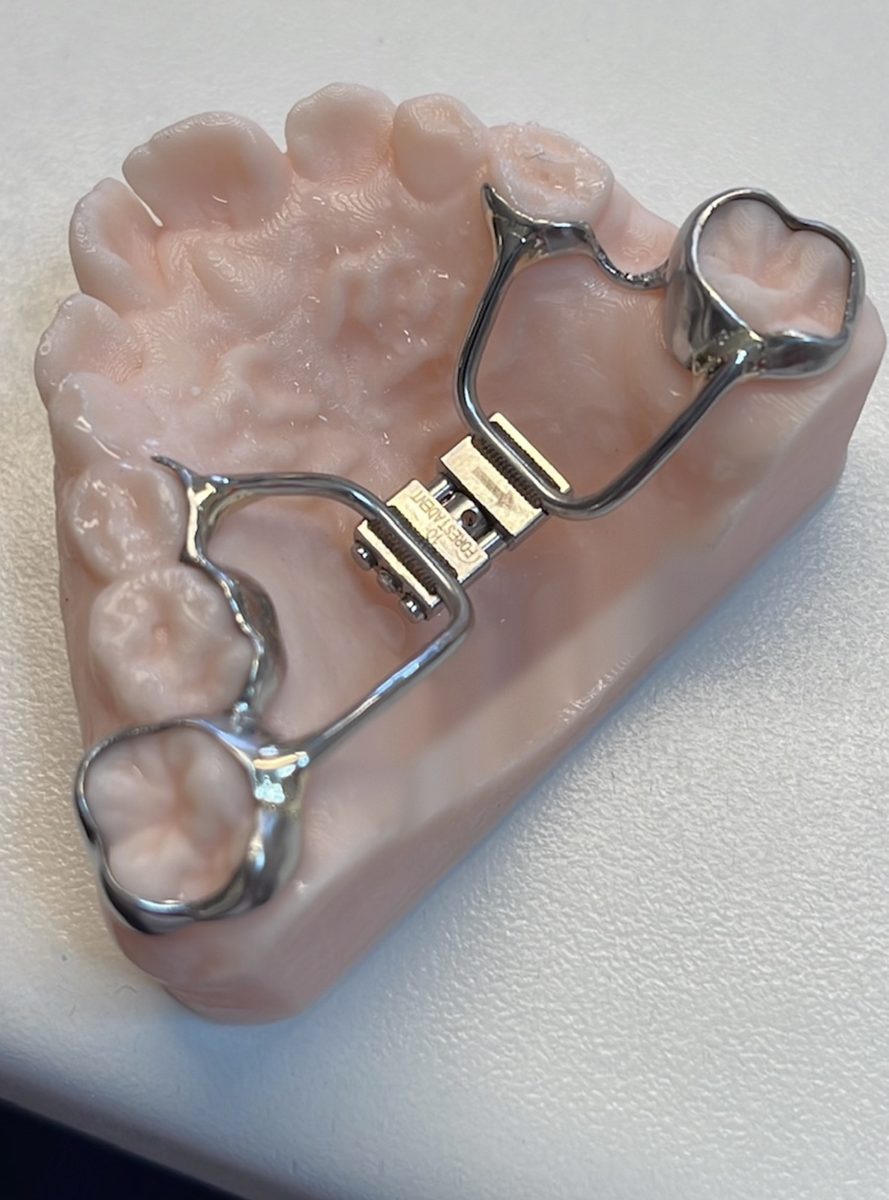
A sintered RME is designed in 3D on the patient’s intraoral scan, then laser-sintered as a single cobalt chrome framework. The expansion screw (we use an 11 mm Forestadent RME screw) is laser-welded in place. There are no hand-adapted bands and no solder joints.
How they compare
- Fit: a sintered framework is designed on the patient’s own anatomy and prints as designed. A soldered RME depends on how well each band is adapted and each joint is made.
- Separators: cap and partial-coverage sintered designs stay clear of the contact points, so separators are usually not needed. That’s one less appointment, which children and parents notice. Banded designs normally need them.
- Bite: occlusal caps open the bite slightly, which can help in deep-bite cases. If you’d rather avoid that, we can design band-style rings instead.
- Strength and adjustment: cobalt chrome is stiffer than stainless steel. Any changes you need are built into the design rather than adjusted chairside.
- Records: a sintered RME needs an intraoral scan. A soldered RME can be made from a scan or from impressions.
- Remakes: the sintered design stays on file, so it can be reprinted without new records if the teeth haven’t moved.
- Turnaround: sintered RMEs take about 1 week from when we receive the scan and prescription, plus delivery.
Bone-anchored designs
We can also design MARPE or hybrid hyrax expanders with sleeves for mini-screws. For these we need a CBCT so we can plan the screw positions.
What to send
- A full upper scan including the palate, plus the lower arch and bite.
- Your prescription on our lab ticket: anchor teeth, caps or bands, screw and any extras such as hooks or buccal tubes.
- If you’d like to approve the design before it’s printed, just ask and we’ll send it over.